“Sælig Suffolk”: Kevin Algar’s poetic journey leads readers from Lowestoft to Iken, weaving Suffolk’s landscape, history, and Christian heritage into lyrical reflections. Drawing on his expertise as a gardener and historian, Algar’s verses in this genre of heritage poetry offer inspiration, practical wisdom, and a sense of wonder, making this collection a soulful guide.
Sælig Suffolk-Artistry, Memory, and Vulnerability
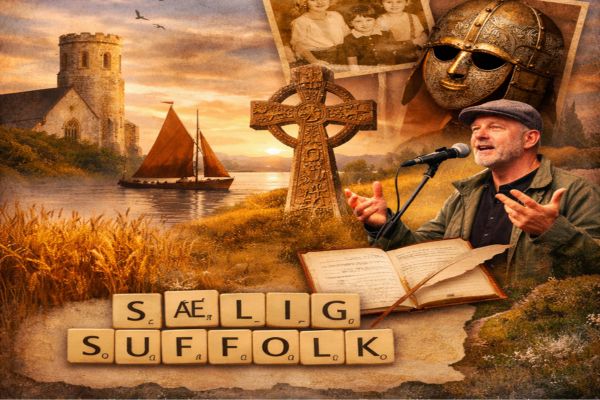
In “Sælig Suffolk“, Kevin Algar embarks on a journey through the personal and family history of the lyrical self, through small glimpses of childhood and adulthood, and through the heart of Suffolk. Within its pages, the notion is also questioned, and due weight is given to interactions that have been crucial to the protagonist’s emotional development.
As readers of heritage poetry, we turn to this book to bear witness to it. To observe its naming in the form of art, in the verbal and pictorial voice: poems that originate from the author’s family album; collages, cutouts, and superimpositions of symbolic objects that rewrite history; verses built upon the robust vulnerability.
Poetic Power and Emotional Roots
This selection of poems and imageries from “Sælig Suffolk” reveals, first, the author’s poetic power, latent in his skill as an interdisciplinary artist, but also the dual, seemingly contradictory nature of this return to roots: works of unusual sweetness that coexist with emotional, powerful memories in this collection of heritage poetry.
Poetic Portraits of Place and Spirit
Heritage poetry is a contemporary form of spoken word poetry that draws on oral tradition to unite communities through live storytelling. Rooted in spoken word and street poetry, this poetic expression combines performance, improvisation, and emotion to create a unique spectacle that resonates with urban culture.
Immerse yourself in the world of heritage poetry withKevin Algar and discover how it keeps the tradition of the spoken word alive, transforming the connection between the past and the present.
Origins of Heritage Poetry and Its Roots in Oral Tradition
Heritage poetry was born to make poetry more participatory and less elitist. But let’s go back a little further. Its roots lie in ancient oral practices. Oral tradition has been fundamental to the transmission of stories and knowledge across diverse cultures, from the rhapsodes of ancient Greece to the griots of West Africa.
These storytellers were experts in storytelling and used oral expression techniques that combined rhythm, rhyme, and emotion. It is no coincidence that heritage poetry shares similarities with these forms, because, like the ancient minstrels’ performing art, it seeks to connect emotionally with the audience through the spoken word.
- In heritage poetry, the poet’s voice becomes as important as the verse itself.
- The improvised rhymes and audience interaction evoke the verbal sparring of the bards.
- This movement is a renewal of the poetic act, which once took place in town squares and courts, and now takes over urban and cultural stages.
Furthermore, heritage poetry has found significant resonance with cultural identity, reflecting the diversity of its performers’ everyday language. In short, slam poetry is not only a tribute to these ancient practices but a reinvention of them to adapt to the challenges and needs of the 21st century.
Saints, Stories, and Sacred Landscapes
Heritage poetry is not simply a modern phenomenon; it is a bridge between ancestral practices and contemporary expression. This connection is established through elements such as oral storytelling and the liberation of the voice, which have always been essential tools for cultural transmission.
In ancient times, societies used storytellers and orators to preserve their histories and knowledge. The powerful impact of live storytelling could move an audience long before words were written down.
In “Sælig Suffolk”, heritage poetry retains this essence, drawing on traditions such as those of Celtic bards and African griots to deliver a vibrant, life-filled message.
How does heritage poetry connect so deeply with the oral tradition?
Through the use of language as a tool for poetic performance, and the ability to move and engage the audience. Here, improvisation and the emotions it expresses find echoes in these ancient practices, allowing poets not only to recite but also to experiment and revolutionise, creating a continuum between the stories of the past and the voices of the present.
Wisdom Rooted in the Land
Heritage poetry has impacted urban culture in ways that go far beyond the microphone and the stage. As a powerful tool for expression, it serves as a megaphone for those seeking to challenge social norms and articulate unique personal narratives. In a society where individual voices are often suppressed, slam becomes a refuge and a platform for personal expression and creative liberation.
Added to this is its inclusive nature; heritage poetry is open to all voices, from young people in neighbourhoods to activists advocating for social change. This openness fosters an engaged audience eager to hear multiple perspectives in a single space. Often, these events become meeting places for art and poetry lovers, strengthening the artistic community surrounding poetry.
Regarding its global impact, heritage poetry…
Heritage poetry is characterised by its inherent connection to oral tradition, with distinctive stylistic features that evoke ancestral storytelling practices. One of the main features is its performative nature, in which the poet’s rhythm and intonation play a fundamental role, akin to ancient storytellers.
These characteristics manifest as improvised rhymes and everyday language, allowing the poet to connect directly and emotionally with the audience. This art of words becomes a collective and dynamic experience, where constant interaction with the audience facilitates a profound cultural and emotional exchange.
Rhythm and Poetry: The poetry’s cadence is crucial. A good command of rhythm amplifies the poet’s message.
Body Expressiveness: Beyond words, poets use gestures and movements to enhance their narratives.
Collective Imagination: Like the ancient singers, heritage poetry allows for the painting of auditory images that the audience projects in their minds.
In short, heritage poetry is not only a place where emotions find their voice, but also a celebration of the human legacy of storytelling. This process keeps alive the heritage of shared wisdom woven through oral communication.
Inspiration for Today from Suffolk’s Past
With “Sælig Suffolk”, Kevin Algar has inspired a number of events and artists who have captured the essence of this poetic movement. These artists stand out not only for their success in poetry competitions but also for the way they use heritage poetry to inspire, challenge, and connect people from diverse backgrounds and experiences worldwide.
Dive into Sælig Suffolk and let Kevin Algar’s evocative poetry inspire and delight you—start reading today!